
Discover what Agentic AI is and how it works in this easy-to-understand guide. Learn about autonomous AI agents, their capabilities, real-world applications, and how they’re transforming the way we interact with artificial intelligence.
Imagine having a super-smart assistant who doesn’t just answer your questions but actually does things for you. Not the kind that waits for your every command, but one that thinks ahead, makes decisions, and gets stuff done on its own. Sounds like science fiction? Well, welcome to the world of Agentic AI!
Think of it this way: traditional AI is like having a really knowledgeable friend who can answer any question you throw at them. Agentic AI, on the other hand, is like having a proactive colleague who not only knows the answers but also rolls up their sleeves and tackles the work without you having to micromanage every step.
Whether you’re a curious tech enthusiast, a business professional looking to understand the next wave of AI, or just someone who loves learning about cool new technology, you’re in the right place. Let’s dive into this fascinating world together and uncover what makes Agentic AI so special!
What Exactly is Agentic AI?

Let’s break this down in the simplest way possible.
Agentic AI refers to artificial intelligence systems that can act as autonomous agents. But what does “autonomous agent” actually mean? Great question!
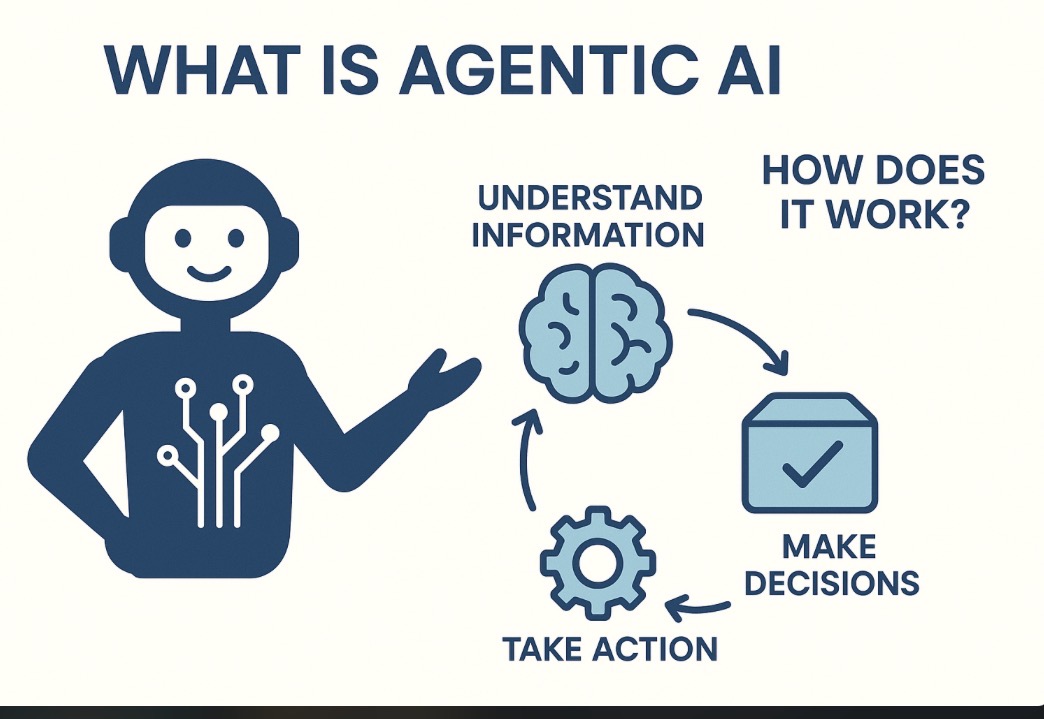
An agent in AI terms is a system that can:
- Perceive its environment (understand what’s happening around it)
- Make decisions based on what it observes
- Take actions to achieve specific goals
- Learn and adapt from its experiences
The “agentic” part emphasizes the autonomy and goal-directed behavior of these systems. Unlike traditional AI that responds to direct prompts and then stops, agentic AI can break down complex tasks, plan multiple steps, execute them, and even course-correct when things don’t go as planned.
The Key Difference
Here’s a simple comparison to make this crystal clear:
Traditional AI (like basic chatbots):
- You: “What’s the weather like?”
- AI: “It’s 75°F and sunny.”
- End of interaction
Agentic AI:
- You: “I need to plan a picnic this weekend.”
- AI: Checks weather forecasts, suggests the best day, finds nearby parks, creates a shopping list, checks your calendar for availability, and even sends calendar invites to your friends
- Multiple actions completed autonomously
See the difference? Agentic AI doesn’t just provide information—it takes initiative and completes entire workflows!
The Core Capabilities of Agentic AI
What makes these AI agents so powerful? Let’s explore their superpowers:
1. Goal-Oriented Thinking
Agentic AI understands the end goal and works backward to figure out how to achieve it. If you ask it to “increase website traffic,” it doesn’t just give you tips—it might analyze your current traffic, identify opportunities, suggest content strategies, and even draft blog posts or social media content.
2. Multi-Step Reasoning
These systems can plan complex sequences of actions. They think in steps: “First, I need to do this, then that, and if this happens, I’ll adjust by doing this other thing.” It’s like having a chess player who thinks several moves ahead.
3. Tool Usage
Here’s where it gets really cool. Agentic AI can use various tools and resources to accomplish tasks. Need to send an email? It can access your email client. Need data analysis? It can run code and generate reports. Need to book a meeting? It can check calendars and send invites. It’s like having digital hands that can interact with your software ecosystem.
4. Memory and Context
Agentic AI systems maintain context across interactions. They remember what you discussed earlier, understand ongoing projects, and build on previous conversations. It’s not starting from scratch every time you interact with it.
5. Self-Correction and Learning
When something doesn’t work as expected, agentic AI can recognize the mistake, analyze what went wrong, and try a different approach. This ability to learn from failures and adapt is incredibly powerful.
6. Decision-Making Under Uncertainty
The real world is messy and unpredictable. Agentic AI can make reasonable decisions even when it doesn’t have complete information, weighing options and choosing the most promising path forward.
How Does Agentic AI Actually Work?
Now let’s peek under the hood and understand the mechanics. Don’t worry—we’ll keep it simple and jargon-free!
Step 1: Understanding the Goal
Everything starts with a goal or objective. You might say, “Help me prepare for my presentation next week.” The agentic AI first needs to understand what you really want. It breaks down this vague request into specific sub-goals: research the topic, create slides, find relevant images, write speaker notes, and practice timing.
Step 2: Planning the Approach
Once the goal is clear, the AI creates a plan. This is like creating a roadmap with multiple checkpoints. The AI thinks: “To prepare this presentation, I need to research the topic first, then outline the key points, then design slides, then gather supporting data, and finally help with practice.”
This planning phase often uses techniques like:
- Reasoning chains: Breaking complex problems into logical steps
- Tree search: Exploring different possible approaches and selecting the best one
- Goal decomposition: Splitting big goals into smaller, manageable tasks
Step 3: Taking Action
Here’s where the magic happens. The agentic AI starts executing the plan by interacting with various tools and systems:
- Retrieval: It might search the web, access databases, or pull information from documents
- Computation: It can run code, perform calculations, or analyze data
- Communication: It can send messages, make API calls, or interact with other software
- Creation: It can generate text, create images, or build documents
Each action is purposeful and moves toward the overall goal.
Step 4: Observation and Feedback
After taking an action, the AI observes the results. Did the web search return useful information? Did the code run successfully? Was the email sent? This feedback loop is crucial because it tells the AI whether it’s on the right track.
Step 5: Adaptation and Course Correction
Based on the feedback, the AI decides what to do next. If something worked well, it continues along that path. If something failed or produced unexpected results, it adapts the plan. Maybe it tries a different search query, uses an alternative tool, or approaches the problem from a different angle.
Step 6: Iteration Until Success
The AI keeps cycling through this process—taking actions, observing results, adapting its approach—until it achieves the goal or determines that it needs to ask you for more guidance.
The Technical Foundation
Behind the scenes, agentic AI typically relies on:
Large Language Models (LLMs): These provide the reasoning, language understanding, and generation capabilities. Think of them as the “brain” that processes information and makes decisions.
Agent Frameworks: Software structures that manage the planning, execution, and memory components. These frameworks orchestrate how the AI interacts with tools and manages its workflow.
Tool Integration Layers: APIs and connectors that allow the AI to interact with external systems like databases, web services, code executors, and various applications.
Memory Systems: Databases or storage mechanisms that keep track of conversation history, learned patterns, and contextual information across sessions.
Feedback Mechanisms: Systems that evaluate whether actions succeeded and guide the AI’s next steps.
Examples: Agentic AI in Action
Let’s look at some concrete examples to make this even more tangible:
Example 1: The Research Assistant
Your request: “I need to understand the market for electric vehicles in Europe.”
What traditional AI might do: Provide a summary of what it knows about the EV market from its training data.
What agentic AI does:
- Searches for the latest market reports and statistics
- Identifies key players and market trends
- Fetches recent news articles about policy changes
- Analyzes sales data from multiple sources
- Creates charts and visualizations
- Compiles everything into a comprehensive report
- Highlights the most important insights at the top
Example 2: The Coding Partner
Your request: “Build me a simple to-do list app.”
What agentic AI does:
- Clarifies requirements by asking targeted questions
- Plans the architecture and tech stack
- Writes the HTML, CSS, and JavaScript code
- Tests the code by running it
- Identifies bugs or issues
- Fixes the problems and re-tests
- Adds documentation and usage instructions
- Suggests potential improvements
Example 3: The Business Analyst
Your request: “Why did our sales drop last month?”
What agentic AI does:
- Accesses your sales database
- Compares last month’s data with historical trends
- Segments the analysis by product, region, and customer type
- Checks for external factors like holidays or market events
- Identifies specific products or regions with the biggest drops
- Correlates findings with marketing campaigns and pricing changes
- Generates visualizations showing the patterns
- Provides actionable recommendations based on the findings
Example 4: The Personal Scheduler
Your request: “I need to schedule coffee meetings with five potential clients this week.”
What agentic AI does:
- Checks your calendar for available time slots
- Emails each client with multiple time options
- Tracks responses and confirms meetings
- Finds coffee shops near each client’s location
- Adds meetings to your calendar with location details
- Sets reminders 30 minutes before each meeting
- Sends you a briefing document about each client before their meeting
The Building Blocks: What Makes It Possible?
Understanding agentic AI wouldn’t be complete without knowing what technological advances made it possible:
Advanced Language Models
Recent breakthroughs in large language models have given AI systems unprecedented reasoning abilities. These models can understand context, follow complex instructions, and generate human-like responses.
Reinforcement Learning
This technique teaches AI systems through trial and error, helping them learn which actions lead to successful outcomes. It’s like how we learn from experience—trying things, seeing what works, and adjusting our approach.
Function Calling and Tool Use
Modern AI systems can now interact with external tools through APIs and function calls. This ability to “reach out” and use different resources dramatically expands what they can accomplish.
Chain-of-Thought Reasoning
This technique allows AI to “show its work” by breaking down reasoning into step-by-step thoughts. It’s similar to how a student solves a math problem by writing out each step rather than jumping to the answer.
Memory Architectures
Systems that allow AI to store and retrieve information across sessions create continuity and learning over time. Short-term memory helps with current tasks, while long-term memory enables learning from past interactions.
The Benefits: Why Agentic AI Matters
Why should you care about agentic AI? Here’s what makes it so valuable:
Productivity Multiplication
Instead of spending hours on routine tasks, you can delegate entire workflows to AI agents. This frees you up to focus on creative, strategic, or interpersonal work that requires human judgment.
24/7 Availability
AI agents don’t sleep, take breaks, or need vacations. They can work around the clock, handling tasks whenever they arise.
Consistency and Accuracy
Once properly configured, agentic AI performs tasks the same way every time, reducing human error and maintaining quality standards.
Scalability
Need to analyze 10 documents? How about 10,000? Agentic AI scales effortlessly to handle workloads that would be impossible for humans to tackle manually.
Personalization
These systems learn your preferences, communication style, and work patterns over time, becoming increasingly tailored to your specific needs.
Cost Efficiency
While there’s an initial investment, agentic AI can dramatically reduce the time and resources needed for many business processes.
Current Limitations and Challenges
Let’s be real—agentic AI isn’t perfect (yet!). Here are some important limitations to understand:
Hallucinations and Errors
AI can sometimes generate incorrect information with confidence or make mistakes in reasoning. Human oversight remains important, especially for critical decisions.
Lack of True Understanding
Despite impressive capabilities, these systems don’t “understand” in the way humans do. They excel at pattern matching and following learned behaviors but lack genuine consciousness or common sense.
Security and Privacy Concerns
Giving AI agents access to tools and data raises important questions about security, data protection, and potential misuse.
Expensive to Run
The computational resources required to run sophisticated agentic AI systems can be substantial, though costs are decreasing over time.
Dependence on Quality Input
The old saying “garbage in, garbage out” applies here. Poorly defined goals or low-quality data can lead to suboptimal results.
Ethical Considerations
Questions about accountability, bias, job displacement, and appropriate use cases need careful consideration as this technology develops.
The Future of Agentic AI
Where is all this heading? Here are some exciting possibilities on the horizon:
Multi-Agent Collaboration
Imagine multiple specialized AI agents working together—one focused on research, another on analysis, another on communication—collaborating like a team to accomplish complex projects.
Deeper Integration
As agentic AI becomes more reliable, we’ll see it integrated into more aspects of our personal and professional lives, from healthcare to education to entertainment.
Enhanced Reasoning
Future systems will have even more sophisticated reasoning abilities, better common sense understanding, and improved ability to handle ambiguous or novel situations.
Physical World Integration
Agentic AI won’t just exist in software. Combined with robotics, these systems could take physical actions in the real world, from manufacturing to healthcare assistance.
Personalized AI Companions
We may each have personal AI agents that understand our unique preferences, goals, and contexts, acting as lifelong assistants that grow more helpful over time.
How to Get Started with Agentic AI
Excited to try this yourself? Here’s how you can start exploring:
For Individuals
Start with AI assistants that have agentic features: Many modern AI platforms now include capabilities that let them perform multi-step tasks, use tools, and work more autonomously.
Experiment with clear, goal-oriented requests: Instead of asking simple questions, try giving the AI complete tasks to accomplish. Be specific about your goals and observe how it approaches the work.
Learn prompt engineering: Understanding how to communicate effectively with AI agents will help you get better results.
For Businesses
Identify repetitive workflows: Look for tasks that follow predictable patterns but consume significant time—these are ideal candidates for agentic AI.
Start with low-risk pilots: Test agentic AI on non-critical processes first to understand its capabilities and limitations in your context.
Invest in integration: The power of agentic AI comes from its ability to interact with your existing tools and systems, so prioritize integration planning.
Train your team: Help people understand how to work alongside AI agents rather than viewing them as replacements.
FAQ (Frequently Asked Questions)
Q: Is agentic AI the same as AGI (Artificial General Intelligence)?
A: No, agentic AI is not AGI. While agentic AI can autonomously complete tasks and make decisions within specific domains, it’s still narrow AI operating within defined parameters. AGI would be AI with human-level intelligence across all domains, which doesn’t exist yet. Think of agentic AI as a very capable specialist rather than a generalist.
Q: Can agentic AI replace human workers?
A: Agentic AI is better viewed as a tool that augments human capabilities rather than a complete replacement. It excels at automating repetitive, data-heavy, or routine tasks, freeing humans to focus on creative, strategic, and interpersonal work. Some jobs will evolve, and new roles will emerge around managing and collaborating with AI agents.
Q: How is agentic AI different from robotic process automation (RPA)?
A: RPA follows rigid, pre-programmed rules to complete specific tasks exactly the same way every time. Agentic AI, on the other hand, can reason, adapt to new situations, handle unexpected challenges, and figure out how to accomplish goals without being given explicit step-by-step instructions. It’s the difference between following a recipe and being able to improvise a meal.
Q: Is agentic AI safe to use?
A: Safety depends on implementation. Reputable agentic AI systems include guardrails, human oversight options, and security measures. However, it’s important to carefully control what access and permissions you give AI agents, monitor their actions (especially initially), and maintain human oversight for critical decisions. The technology is powerful, which means responsible deployment is essential.
Q: Do I need technical expertise to use agentic AI?
A: Not necessarily! While building agentic AI systems requires technical knowledge, using them is becoming increasingly accessible. Many platforms offer user-friendly interfaces where you can interact with AI agents through natural language. That said, understanding the basics (like we’ve covered in this article) will help you use these tools more effectively.
Q: How much does agentic AI cost?
A: Costs vary widely depending on the complexity and scale. Some platforms offer free tiers or subscription plans starting at $20-50 per month for individuals. Enterprise solutions can range from hundreds to thousands of dollars monthly. The good news is that as the technology matures, it’s becoming more accessible and affordable.
Q: Can agentic AI work offline?
A: Most powerful agentic AI systems currently require internet connectivity to access their underlying models, tools, and resources. However, research is ongoing into more efficient models that could run locally on devices. Some simpler agentic behaviors can work offline, but with limited capabilities.
Q: What industries benefit most from agentic AI?
A: Nearly every industry can benefit, but some seeing particular impact include customer service (automated support agents), software development (coding assistants), research and analysis (data analysts), content creation (writing and marketing), healthcare (administrative tasks and research), finance (analysis and reporting), and education (personalized tutoring).
Q: How do I know if the AI agent made a mistake?
A: Always verify important outputs, especially at first. Most agentic AI systems can explain their reasoning if you ask. Start with low-stakes tasks, gradually increase complexity as you build trust, implement review checkpoints for critical work, and maintain human oversight for final decisions. Over time, you’ll develop intuition for when to double-check results.
Q: Will agentic AI keep getting smarter?
A: Yes! The field is advancing rapidly. AI models are becoming more capable, reasoning abilities are improving, tool integration is expanding, and efficiency is increasing while costs decrease. Expect agentic AI systems to become significantly more powerful and useful over the next few years.
Conclusion
We’ve covered a lot of ground together! Let’s recap what makes agentic AI such a game-changer:
Agentic AI represents a fundamental shift in how we interact with artificial intelligence. Rather than passive tools that wait for commands, these systems are proactive partners that understand goals, make plans, take actions, and adapt along the way. They combine sophisticated reasoning with the ability to use tools and complete complex, multi-step tasks autonomously.
The technology works through a continuous cycle of understanding goals, planning approaches, taking actions, observing results, and adapting strategies. Built on advanced language models, reinforcement learning, and sophisticated integration frameworks, agentic AI can tackle workflows that previously required significant human time and effort.
From research and analysis to coding and scheduling, agentic AI is already transforming how we work. While limitations exist—including potential errors, security concerns, and ethical considerations—the benefits of increased productivity, scalability, and consistency are compelling.
The future promises even more capable systems that collaborate with each other, integrate more deeply into our lives, and handle increasingly complex challenges. But you don’t have to wait for the future—you can start exploring agentic AI today.
The most important thing to remember? Agentic AI is a tool designed to work with you, not replace you. It handles the routine, time-consuming, and data-intensive work, freeing you to focus on what humans do best: creative thinking, emotional intelligence, strategic decision-making, and building meaningful relationships.
Whether you’re excited, curious, or maybe a little apprehensive about this technology, the best approach is to start learning, experimenting, and discovering how agentic AI can enhance your work and life. The technology is here, it’s accessible, and it’s ready to become your tireless, intelligent collaborator.
Welcome to the age of agentic AI. Your most productive and exciting journey with technology is just beginning!
Ready to explore more? Start experimenting with agentic AI tools today and discover how they can transform your workflows. The future of work isn’t just artificial—it’s intelligently agentic.